Advancements in Tube Fabrication for the Aerospace Industry

Updated: May 20
Precision Requirements in Aerospace Tubing
In aerospace manufacturing, reliability and performance begin with the materials and processes behind every component. Tube fabrication is one of the most critical steps in producing systems that manage fluids, gases, and structural integrity under high stress and variable conditions.
The requirements that govern tubing in flight systems are tolerance control, controlled material selection, and inspection that leaves a record. TEC holds bend angle to plus or minus 1 degree and overall length to plus or minus 1/16 inch, verified in-house against the customer drawing.
Weight Reduction and Bend Quality
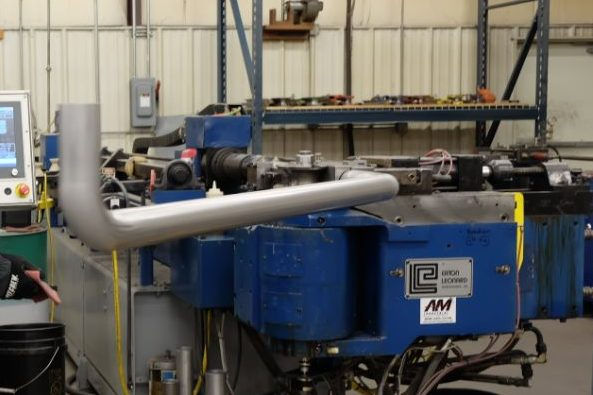
In aerospace, every pound matters. Cutting weight without giving up strength drives both material choice and bend method. Mandrel bending contributes directly, because supporting the tube interior through the bend holds the wall and the flow area where a crush bend would collapse them. TEC bends wrinkle-free and holds ovality at no more than 7 percent, with wall thinning under 12.5 percent on 3XD bends.
Flight programs commonly specify nickel-based superalloys and titanium for these duties. TEC's documented material range covers titanium, 304 and 409 stainless, aluminized steel, and aluminum, all bent on US-produced steel stock where carbon steel applies.
CNC Tube Bending and Repeatability
CNC tube bending produces consistent, repeatable results across a production run. The machines control angle and radius closely enough to bend features into a single piece instead of joining shorter sections, which removes fittings, removes potential leak points, and takes weight out of the assembly.
Geometry has to be verified before an assembly ships. TEC validates part accuracy in-house using ROMER arm measurement and 3D scanning, checking the finished part against the drawing and catching deviation before it reaches a production line.
Materials that Withstand Aerospace Conditions
Aerospace tubing is subjected to thermal cycling, vibration, pressure fluctuations, and environmental exposure. Material selection follows those loads rather than the other way around, which is why the grade is specified on the drawing before any tooling decision gets made.
Materials like stainless steel and specialty nickel-based alloys are commonly selected to meet these challenges.
Compliance in a regulated program rests on documented process control rather than on any single inspection step. TEC operates under an ISO 9001:2015 certified quality management system, which is the baseline most OEM procurement groups screen for before a supplier reaches a quote.
Simulation and Modeling in Modern Fabrication
Simulation and digital modeling have moved into fabrication planning across the industry. Stress concentration, flow behavior, and heat exposure can be modeled before tooling is committed, which moves the expensive discoveries earlier.
This predictive capability enhances design accuracy and reduces rework, saving time and ensuring better field performance.
Where These Requirements Overlap
The discipline behind tubing for aerospace systems is tolerance control, material discipline, and inspection that produces a record. Those are the same requirements that govern precision tube assemblies in heavy-duty, off-road, agricultural, and industrial OEM programs, which is where TEC's production runs.
To discuss a precision tube bending requirement, see OEM tube and exhaust manufacturing or contact TEC.
Explore TEC's capabilities:


